

Click Arrow To Start Audio
ACTS: INTRODUCTION
I. LITERARY CLASSIFICATION AND TITLE OF THE BOOK.
A. Historical -
B. The shorter title. "THE ACTS" common in modern translations beginning with the Revised Version.
C. The longer title, "ACTS OF THE APOSTLES" is traceable back to the second century.
1. Some of the Acts of some of the apostles.
2. Not dreams, speculations or theories of the apostles, but actual deeds or acts accomplished.
II. AUTHOR AND DATE OF THE BOOK
A. Luke, the beloved physician (Col.4:14).
1. Comparison of Acts 1:1 with Luke 1:1-
2. "WE" sections: 16:10-
B. Date: A.D.63.
III. PURPOSE OF THE BOOK
A. To present the history of the beginning and early happenings of the church.
B. To show the effective work of the Lord's ambassadors (apostles) in carrying out God's universal redemptive plan following the ascension of Christ.
1. Key Verse: 1:8
a. Jerusalem -
b. Judea and Samaria -
c. Uttermost part of the earth -
IV. IMPORTANCE OF THE BOOK
A. Acts is a pivotal book, bridging the gap and binding the Gospels and the Epistles.
1. A sequel to the Gospels that precede and anticipate it.
2. A background to the Epistles that follow and presuppose it.
B. The Gospels anticipate the church; the Epistles presuppose it; ACTS furnishes the rise and development of it.
C. Without the book (except for some fragmentary allusions in the Epistles) we would have no authentic record of apostolic history and the beginning and early history of the church.
V. FEATURES OF THE BOOK
A. The Holy Spirit is prominent. Name mentioned about 70 times. Acts furnishes and inspired account of the advent and ministry of the Holy Spirit in fulfillment of the promises of Christ to His apostles (cf.John 15:26, 16:13-
SOME EXAMPLES:
1. Promise of coming and fulfillment (Acts 1:4-
2. Reception by Samaritans (8:14-
3. Reception by the Gentiles (10:44-
4. Guidance in Jerusalem conference (15:28)
5. Claims of inspiration (1:16; 4:25; 6:9,10; 28:25)
6. Predictions about Paul (20:22,23; 21:4,11).
7. Sin of lying against (5:1-
B. The resurrection is prominent. Mentioned more than 20 times; focal point in 8 of 13 sermons; implied in others.
SOME EXAMPLES:
1. Luke's introduction (1:3,22).
2. Peter's sermon on Pentecost (2:24,31,32).
3. Peter's sermon on Solomon's porch (3:13,15,26).
4. Paul's sermon in Antioch of Pisidia (13:30,31,33,34,37).
5. Paul's sermon At Athens (17:18,31,32).
6. General references: 4:33; 25:19.
C. Conversions are prominent. SOME EXAMPLES:
1. About 3,000 Jews on Pentecost (2:37-
2. Simon and other Samaritans (8:4-
3. Saul (9:1-
4. Ethiopian (8:26-
5. People in Lydda and Sharon (9:32-
6. People in Joppa (9:36-
7. Cornelius and household (10:1-
8. Greeks at Antioch of Syria (11:19-
9. Lydia and household (16:11-
10. Philippian jailor (16:25-
11. Crispus and Corinthians (18:8).
12. Other references 2:47; 4:4; 5:14; 6:7; 9:31; 12:24; 16:5.
D. Acts records 5 visits of Paul to Jerusalem after his conversion (9:26-
E. Acts furnishes the background for 10 of Paul's Epistles:
1. I & II Thessalonians.
2. I & II Corinthians.
3. Galatians.
4. Romans.
5. Colossians.
6. Philemon.
7. Ephesians.
8. Philippians.
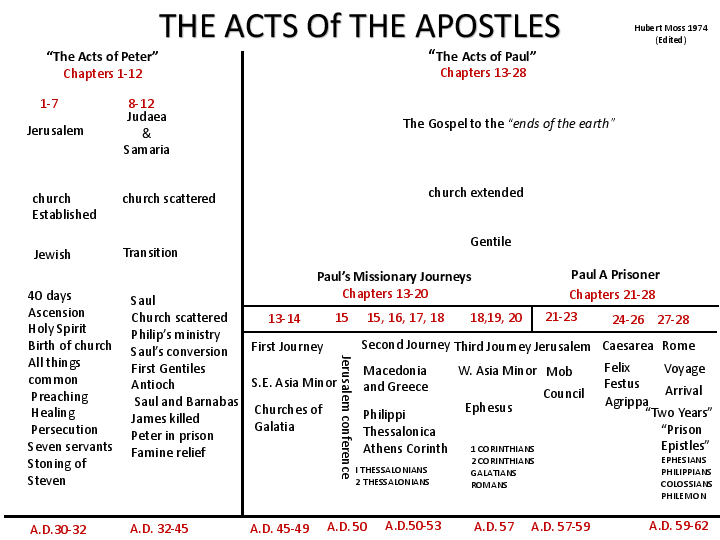
F. Major divisions: (See Chart)